
GO BACK
A very special family celebration
November 28, 2025
Our end-of-year family day is a highlight for many families in our care.
It offers a chance to wrap up the year with joy and connection, and welcome the festive season in a relaxed, inclusive setting.
This year, more than 300 children, siblings, parents, carers and extended family joined us on the front lawn at Very Special Kids.
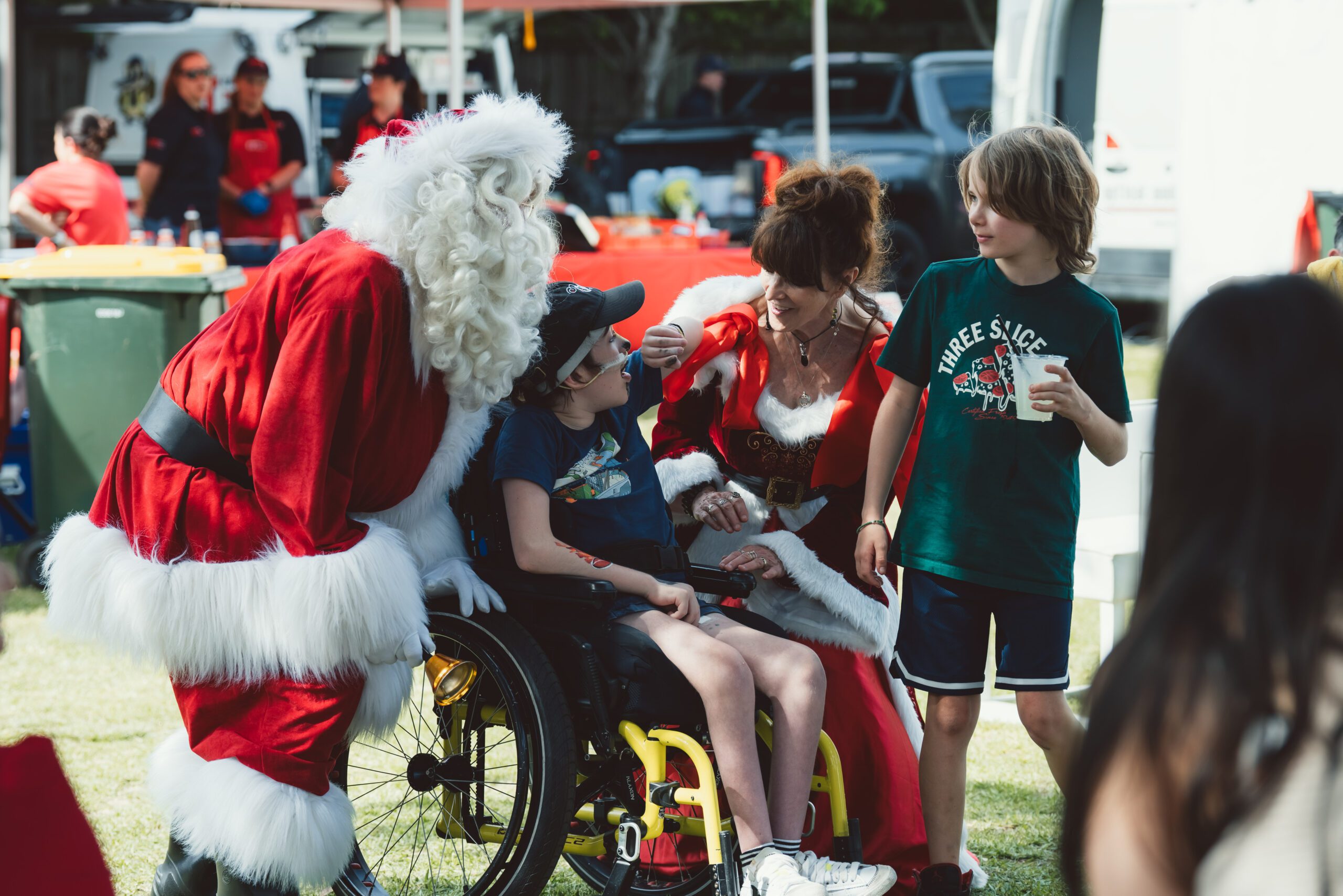
We’d like to thank the wonderful generosity of Rapid Relief Team for catering a delicious BBQ lunch, and Good Vibes Society Charity for providing some sweet treats. Thanks also to Wallop Water for keeping everyone hydrated!
Among the many activities families enjoyed, one tradition stood out for its meaning and impact. Capturing a Santa photo or an end-of-year portrait is a cherished tradition for many families – but for those caring for a child with a life-limiting condition, it can sometimes feel out of reach. Busy shopping centres and overwhelming environments often make the experience stressful, if not impossible.
Thanks to the generosity of Heartfelt, who provided three photographers, families at our celebration enjoy professional roaming, Santa photos and portraits in a calm, welcoming space, offering a precious keepsake.
During the day, there was plenty to keep everyone entertained. The Reptile Encounters team kept everyone on their toes, introducing us to some scaly, slimy and furry friends! We also had Animals on the Move there for some more fluffy interactions!
Children lined up for colourful and festive face painting, and families were thrilled to meet their heroes from the Spider-Verse. Adding to the thrill, Melbourne City Wrestlers also delivered an energetic display and were even challenged by some of the kids to a friendly arm-wrestling match!
Another much-loved tradition was also an appearance from vehicles and officers from the Malvern and Windsor Fire Stations, and Malvern Police Station.
Bubble Tonic wowed the crowd with their mesmerising bubble art, magician Lachlan Wilde delighted families and children alike with his magic tricks, while Wild Canary serenaded families throughout the day with their favourite tunes. The Icecream Delights truck was also a big hit, with many smiling faces.
A big thank you to our Youth Advisory Group, who brought creativity and fun to the day with interactive games and unique prizes that kept kids engaged.
Families were also delighted to receive gifts generously donated by our corporate partner, efm Logistics, adding an extra touch of joy to the celebration.
This incredible day wouldn’t have been possible without the dedication of our amazing volunteers. From planning to packing up and all the activities in between, their hard work ensured everything ran smoothly, and we’re so grateful for the care and energy they bring to every event.
We also extend a sincere thank you to our generous suppliers and partners, many of whom donated their time and services to make this celebration truly special. Your support helps create moments that families will remember long after the day ends.
Last but certainly not least, thank you to all the families who joined us and helped make this celebration so memorable. Your laughter, smiles and shared moments are what truly brings this day to life.
GO BACK
A message to bereaved fathers from Ladybird Care Foundation
November 27, 2025
Ladybird Care Foundation are partnering with Very Special Kids to work toward our mission that no bereaved parent walks this journey alone.
The Ladybird Care Peer Mentor Program enables connections and companionship between newly bereaved peers (Peer Mentees) and Peer Mentors (parents more than two years bereaved who have undertaken training to become a Peer Mentor).
If you would like to learn more about the Peer Mentor Program, click here.
We are seeking interest from Very Special Kids’ bereaved fathers, to join an online information session hosted by Ladybird Care Foundation that will bring together the voices of fathers that have experienced the death of their child and the meaningful difference that being part of the Mentoring program has made for them on their grief journey. The session will be held during a weekday lunch hour or late afternoon in mid-February 2026 and will give you the opportunity to ask lots of questions about the program.
To help us plan, please register your interest here. Even if you can’t attend the proposed time, please still register and we will try and accommodate as many of you as we can.
If you have any questions please contact Damienne on dmor@vsk.org.au or 0487 523 155.
About Ladybird Care Foundation
Ladybird Care Foundation was founded by a bereaved father Wayne Pascoe and his core group of friends to honour his daughter Emma.
Not wanting other parents and families to experience their grief journeys alone, they became passionate about finding a way to help others and Ladybird Care Foundation was formed. Read more here.
We are delighted that more than 12 Very Special Kids’ parents have engaged with Ladybird Care Foundation as either Mentors and Mentees and we are already hearing positive stories about the benefits. While many bereaved mothers have engaged with this program, we hope to support just as many fathers to make a connection.
GO BACK
Christmas with Emma and her family
November 24, 2025
Emma’s family holds her extra tight at this time of year, as they don’t know how many more Christmases they will share.
“Here’s Emma with Santa in a photo taken just a couple of weeks ago.
When Emma was first diagnosed, doctors told us she wouldn’t make it to five years old, but this year will be our ninth Christmas with Emma. We are so lucky.
We have a family photo with Santa every year – because it’s a celebration that Emma is still with us.”
– Ashley, Emma’s mum
Many other families just like Emma’s are clinging to every precious moment this Christmas.
Your gift today will help surround families like Emma’s with comfort and support, so they don’t have to face this time of year alone. Donate here today.
Emma’s world is full of all the things most eight-year-old girls love – a Frozen-themed bedroom, Disney movies, the swimming pool and even wrestling games with her older brother Matty, and visits to the local shopping centre to have family portraits done with Santa.
Emma is also non-verbal and requires the support of a wheelchair to get around, she shows joy for her many passions through her contagious happiness and cheeky and loving nature.
What started as routine checks after Emma’s birth quickly turned into a series of diagnoses that turned the young family’s lives upside down.
Even in our darkest hours when everything just seems so dire, you have someone to talk to and be open and honest with how you’re feeling, they make it clear there’s no wrong feelings with what we are going through.
In addition to counselling support, Emma and her family have access to dedicated respite care at Very Special Kids House
The family live in a tight-knit rural community in central Victoria, which has many perks – Emma is well-known and many people go out of their way to make Emma feel special, wanted and part of the community. However, it also means some challenges when accessing specialised medical care.
With the help of the Very Special Kids’ Road to Respite van, Emma can be picked up and dropped off when she stays at Very Special Kids House.
“I love how they have someone sitting in the back with her and they read to her and sing to her and talk to her…It’s nice to know that she’s very well taken care of in the van and even more so at Very Special Kids House.”
Emma’s having a ball
For Ashley and her husband, Brad, the initial respite experience was “nerve-wracking and overwhelming.” Ashley continues, “It’s very daunting leaving just a typical child for a night or two, let alone a special needs child who you’ve done absolutely everything for.”
However, Emma quickly settled in, giving her family the confidence to “let her have her little holiday” because they knew “she’s going to be having an absolute ball.”
“I just watched how Emma took to everything. So we just went in and visited her from time to time to check on her and she barely even noticed us gone which was amazing.”
During her respite visits to Very Special Kids House, Emma’s favourite activities are using the hydrotherapy pool, participating in music and art therapy and sensory activities like finger painting.
Emma’s family love to call Emma every night while she’s at respite and read stories to her to say goodnight.
Ashley shares, “It’s an amazing place, the hospice… that’s why we call it Em’s holiday because these people are there to make sure she’s having a great time 24/7… She gets to make new friends and meet more kids like her.”
Your gift today will help surround families like Emma’s with comfort and support, so they don’t have to face this difficult time of year alone.
I think a lot of people don’t realise that it’s not a bad life. It’s still a beautiful life and she’s still happy. We get this opportunity to spend her life with her. We get this opportunity to love her. Not many people get this. And while it is stressful, it is emotional. It is hard. It is so worthwhile and it is so meaningful and so fulfilling.
There’s no words to describe how thankful we are towards Very Special Kids and what they’ve done for our family.
GO BACK
The long way to home: Sophia’s story
November 7, 2025
When Sophia was born in April 2024, excited first-time parents Zoe and Ken could never have imagined that the first year of her life would be spent mainly in hospital.
They didn’t expect more questions than answers. Or that Sophia would need round-the-clock respiratory support and a tracheostomy at just four months old. And they never imagined that the day after Sophia’s surgery, Zoe would begin chemotherapy for triple-negative breast cancer.
“On the worst days of chemo, I used to FaceTime her,” Zoe recalled. “I could only hold my phone for about five minutes before I had to hang up. I didn’t even know if she knew I was her mum.”
Now home, with Sophia in their arms and Zoe in remission, the couple are taking a moment to breathe. Their bright, cheeky one-year-old, beams at her music therapist, waves at everyone and even plays the piano with her toes.
But getting here wasn’t easy, and the road ahead is still filled with uncertainty.
A series of unknowns
After bringing newborn Sophia home, Zoe and Ken’s concerns began.
“Our gut was screaming that something was wrong,” Zoe remembered. “She was trying to cry with all her might, but no sound was coming out. She was really slow at feeding, her colour was dusky and she was really sleepy.”
As Sophia’s condition worsened, Zoe and Ken rushed their baby girl to the emergency department. “I remember thinking she’s not going to make it through to the morning,” Ken recalled.
The next day, Sophia was transferred to Monash NICU, where she would spend much of the next 10 months.
For a long time, there were no answers, just a mix of emotions and fear. Eventually, genetic testing revealed Sophia had a group of rare hereditary conditions called congenital myasthenic syndromes (CMS), which affects neuromuscular function.
“It felt like we could finally name the monster that was plaguing our family,” said Ken.
For Zoe and Ken, limited research and the many variations of CMS mean that much about Sophia’s future remains uncertain.
Just weeks later, the family faced another devastating blow – Zoe was diagnosed with breast cancer. Her treatment began immediately, overlapping with Sophia’s complex care, hospital transfers and a tracheostomy to help her breathe.
A transition into something like normal
After months in hospital, the family faced a confronting reality: going home meant becoming full-time medical carers overnight.
That’s when Very Special Kids came into their lives and offered a solution – an emergency respite stay in family accommodation at the hospice.
Zoe, Ken and Sophia stayed here for five weeks. During that time, staff helped train specialised carers to support them and coached the couple on medical routines such as suctioning, feeding and how to care for Sophia’s complex medical needs at home.
More importantly, the family began to discover everyday joys.
Sophia went on a swing for the first time. She felt the wind in her hair, played music with Isaac, the music therapist, and painted her first picture.
“She cried when the wind touched her face – she wasn’t used to it,” said Zoe. “It was like she’d been institutionalised.”
Alongside these joyful firsts, Zoe and Ken had space to recover and rest. “It was like a real-life simulation. Very Special Kids helped us figure out what life was going to look like.”
A place where Sophia belongs
Now, the family regularly accesses respite care at Very Special Kids House – and while it’s a break for Zoe and Ken, it’s also an experience that Sophia loves.
“She’s older now, more social,” said Zoe. “She loves Play-Doh, going to the duck pond, music sessions and nail painting. The staff know what makes her happy. The more the nurses get to know her, the more comfortable we get leaving her here”.
Ken added, “It makes it a lot easier for us to trust Very Special Kids. We’ve got that confidence that when we drive off, they can handle a situation.”
The family now trusts the team like an extended family.
“We know she’s going to have fun, that she’ll be looked after by people who genuinely care for her,” said Ken.
Looking forward
Life at home is still complex. Sophia requires 24/7 care, equipment and trained carers day and night. Her day is filled with therapy, hospital appointments and routines that most families never need to consider. But it’s their family life – and it’s filled with love.
“Everything’s taught me a lot of perspective,” said Zoe. “It’s been really hard, but we’re lucky because we’re together and we can support each other”.
Recently, Very Special Kids gave them the confidence to do something they hadn’t done in a long time: go to a wedding and enjoy a dinner out with friends. “Stuff like that just makes you feel a bit more human,” Zoe reflected.
Zoe said it’s hard to put into words what the understanding and care has meant. “We didn’t know about Very Special Kids before this, but now I’d shout it from the rooftops.”
You can help us care for kids like Sophia by supporting the Piggy Bank Appeal during November.
Get involved by:
- Buying a very special piggy bank to help save your coins. Visit our online shop here or visit your local Commonwealth Bank branch
- Enjoying a meal out with friends and family. ALH Hotels will be donating $1 from every garlic bread sold during November – click here for participating venues
- Donate to help fill our piggy banks here.
GO BACK
Kara’s story
October 28, 2025
Kara was a bright, loving little girl whose early days were filled with joy and play alongside her family and their menagerie of pets brimming with guinea pigs, chickens, cat and dog. She adored Bananas in Pyjamas, jewellery and dressing up.
In February 1993 the family relocated from Ballarat to Melbourne. With relatives spread across Australia, parents Susan and Peter worked hard to settle their three children – Kara, one; Scott, three; and David, four – into their new city.
Then, at the young age of 18 months old everything changed for the young family of five.
Noticing Kara’s constant lethargy, Susan asked, “Kara, do you want to go and see a doctor?” Kara nodded. Tests revealed severe anemia – only half her normal blood count.
On 1 September 1993 came the devastating diagnosis: neuroblastoma, stage three, with a tumor ‘the size of a football.’
“I was crying on and off. I couldn’t talk to people without crying,” Susan recalled. What stayed with Susan most was Kara’s extraordinary strength. “She just had this amazing acceptance of what was happening. And she inspires me even today.”
Kara was always calm, never resisting or complaining during regular, painful tests.
A small stuffed pink pig, Ms. Piggy, became her comfort during difficult treatments, which Susan still holds onto.
“Whenever she was in the pusher or going to hospital or having injections or anything, Ms. Piggy was always there.”
“It’s the most horrible feeling to know that you can’t control what’s happening to your child,” Susan recalled.
Life became a balancing act. Susan was breastfeeding, caring for Kara in hospital, and still nurturing her two young boys.
“You feel very alone trying to cope with this incredible task of looking after two small boys. It’s the most awful feeling to know you can’t be everywhere.”
Kara endured challenging treatments – autologous bone marrow chemotherapy, surgery, time on a ventilator – all without a voice or choice in her care. Susan and Peter felt horrified, navigating a situation beyond their control.
For five months, Susan rarely left the hospital. So, support from Very Special Kids volunteers became a lifeline. Jenny, Murielle, Joan and Nancy offered extraordinary care.
Jenny visited twice a week for four hours, giving Susan precious breaks at home and an empathetic shoulder to lean on, “she was so caring and kind. She listened, didn’t judge me, and really advised me.”
The care, thoughtfulness and consistency of these strangers made all the difference. Knowing Kara had one-on-one attention while constantly tethered to machines brought Susan peace.
“Very Special Kids was amazing,” she recalled. “It’s the people who you don’t expect to help you that come forward.
They lift you.”
Sister Margaret Noone’s visits also left a mark on Susan. “She’d always come and talk to me. And just acknowledging you is a big thing.”
When Susan looks back to that time, Very Special Kids were always there. Creating unforgettable moments of joy for her and her family. Christmas parties, outings and events – small breaks in the storm.
“They’re the fun times we remember rather than the difficult times. But if we hadn’t had Very Special Kids give us those fun times, we wouldn’t have had anything extra.”
When Kara died, aged three years and nine months, she was at home, surrounded by love. That night she was in pain and struggled to breathe. Peter wanted to get help. Susan gently told him, “We don’t need to get help. Kara is dying, darling.”
“Even though the child dies, your loss doesn’t stop. It’s a whole lifetime,” Susan reflected. “We live with that knowing that we’ve got that little gap in the family and nothing you can do about it.”
In Kara’s honour, Very Special Kids volunteer Jenny wrote a moving poem, which Susan still treasures on her wall:
As I write the tears of love that gently trickle down,
I think only of you and the peace that you have found.
Here’s to the love and laughter that you have brought my way.
Here’s to the special memories that are here to stay.
Here’s to all the happiness that filled our days together.
Here’s to all the special love that will stay in my heart forever.
And I know I will always be happy as can be,
that the world’s most precious fairy chose to give her love to me.
Still, Susan remains grateful for the care extended beyond Kara’s death. “Very Special Kids would have to be one of my high notes,” she said. “Even when she died, we still got the care. That was the thing. We still got the care.”
As Very Special Kids marks 40 years of support, Kara’s story is a testament to the compassion that sustains families through the hardest journeys – and to the kind, fun-loving, adventuresome person she would’ve been if she was alive today.
GO BACK
Skye’s story
September 5, 2025
Born with a very rare genetic condition called Sanfilippo Syndrome, Skye is one of less than 100 children with the disease in Australia.
As a degenerative disorder, over the years Skye has lost the ability to speak, and is slowly losing mobility amongst other cognitive issues.
For dad Mark, looking back at videos of Skye can be heartbreaking.
“Day in, day out, we don’t notice always the regression,” he says. “Someone showed me a video of her when she was probably about five years old, and she was serving me a plate of food.
“She was cracking pepper on that plate and she was talking a bit in the process. There is no way she could do that now.”
Mark describes the condition as similar to dementia. Receiving the diagnosis was extremely difficult.
“Obviously you think about the future watching them play sport, and all those sorts of things are now gone,” he says. “You go through that grieving process.”
At the same time, Skye’s mum Wanna suddenly lost her hearing which added to the pressure on the family.
Now ten years on from Skye’s diagnosis, and the family has been able to settle into a new normal.
“Once we were able to gather ourselves, we developed a strategy for her that was very, very simple,” Mark says. “Any decision we made for Skye was based through the lens of love, happiness, and the best quality of life that we could deliver.”
That’s where Very Special Kids has been crucial. Since 2016, the family regularly stay at the hospice at Very Special Kids House for respite and have created many lasting happy memories.
Living two hours from Melbourne in Ballarat, a trip to Very Special Kids House includes 24-hour medical care for Skye in a home-like setting while the family can stay in the family accommodation on site.
Those supports are integral to coping with life, Mark says.
We can happily leave Skye with the hospice staff knowing she’s going to have a ball.
Skye is particularly fond of the sensory activities and toys on offer.
The family has also made use of the holiday accommodation at Glen Osmond Farm in Woodend. An oasis packed with all the accessibility features needed that might prevent families from being able to travel.
“Initially, I think we underestimated the toll looking after a special needs kid takes,” Mark admits. “You never switch off. You never fully shut down.”
“Just being able to have that time just to recharge, so we can be at the top of our game to be able to look after her is so important, for us and for Skye.”
It’s been particularly useful for their teenage son Luke, who has been able to catch up with friends in Melbourne and get quality time with his parents that might not have been possible without respite assistance.
“Our son has to make quite a lot of sacrifices,” Mark says. “It plays that part in us being able to invest some time in him.”
Very Special Kids also has a dedicated sibling support program to connect others in similar situations.
Family wellbeing is paramount for Very Special Kids, Mark says.
Very Special Kids gives you that opportunity just to recharge your batteries but also know that we know Skye’s having fun.
GO BACK
A Father’s Day reflection
Written by Nigel, bereaved dad of 17-year-old Olivia who had FOXG1 syndrome and cerebral palsy
August 29, 2025
Father’s Day is often a time for celebration, but for me it has become a day of reflection – looking back on the precious time spent with my daughter Olivia and the incredible support we received from Very Special Kids.
When Olivia entered palliative care, life was turned upside down.
As a father, I wanted to protect her, provide for her and give her a sense of comfort and safety – but the situation was completely new and nothing could have prepared me for it.
Very Special Kids gave me the tools to continue being her dad, even in the most heartbreaking of circumstances. The hospice gave me structure and routine, something steady to hold on to when everything else felt uncertain.
One of the most precious gifts we were given was time in the Very Special Kids’ swimming pool. It may seem like a small thing, but for us, it was everything. In that warm, quiet space, we were able to hold Olivia, play, laugh, and just be together – as a whole family.
For a small amount of time our family was happy and smiling. It was a special time that we would have never have had elsewhere.
The onsite houses allowed me to stay close enough to Olivia to never feel distant, but also gave me the space I needed when emotions became overwhelming.
That balance of closeness and space was something we didn’t know we needed until we had it.
When Olivia passed, the Butterfly Room (also known as the Balam Balam suite) offered me and my family a place of peace.
Family and friends gathered there to spend time with Olivia, to say goodbye and to reflect.
As her father, it gave me the chance to stay close to her, to sit with her and to honour her life with the dignity and love she deserved.
Very Special Kids gave me more than just support during Olivia’s journey – they gave me the chance to still be a father in the truest sense.
They made sure that Olivia’s final months were not just about illness, but about comfort, love and togetherness.
And for me, they gave the strength to keep showing up as her dad, even in the hardest moments.
This Father’s Day, I will carry both the pain of loss and the gratitude of having had that time with her.
Without Very Special Kids, I don’t know how we would have survived those 15 months. They made it possible for me to keep being Olivia’s dad, and a father for the rest of the family – something I will treasure forever.
Olivia 28/4/06 – 19/3/24
GO BACK
Henry’s story
August 27, 2025
Henry was the kind of kid who made friends without saying a word. He had a quiet charm that drew people in — from nurses to classmates and even strangers.
“He only ever made a friend,” his mum Jess says. “It was just so cool to watch.”
Born in Shepparton in 2007, Henry lived with complex medical needs from infancy. He had cerebral palsy, epilepsy, severe respiratory issues and was visually impaired. But Jess is quick to point out that Henry was never defined by his diagnoses.
He brought extraordinary people into our world and made us better people.
I don’t know who I’d be if he hadn’t entered my life.
Henry’s care often meant long hospital stays in Melbourne, away from his siblings and dad, Paul. Jess recalls the whirlwind of specialists, medications, and emergency flights.
“Behind the scenes, there was so much more going on than people realised, but we just did what needed to be done.”
It was during one of those hospital stays that Jess first heard about Very Special Kids. A fellow parent mentioned the organisation, and soon Jess was connected with Jenni, a Shepparton based family support practitioner.
“We couldn’t believe it when she told us all the services that were available,” Jess says.
“There was a level of excitement that there was actually a service out there for the whole family.”
Holistic care now and beyond
Very Special Kids became a constant presence — offering respite, emotional support and connection for the family of five. “They’re the only ones who do the after,” Jess says. “When your child dies, everyone else steps away. But Very Special Kids stay.”
Henry sadly died in 2013. In the years since, Jess has found many ways to honour Henry’s legacy through creativity and advocacy.
In 2010, she founded Made By You, inspired by her time with Henry in hospital. “I saw how important it was for kids to experience joy beyond their illness,” she says. “To express the essence of who they are.”
Made By You is a vibrant art-centred project that gives children with life-limiting conditions the chance to design their own t-shirt — a reflection of their personality, not their diagnosis. “The dream was that someone would ask, ‘Is that made by you?’” Jess says. “And the child could say, ‘Yes,’ with pride.”
Jess has kindly dedicated time to craft unique t-shirt creations at our sibling days, hospice and family events.
“Some kids are so particular with their designs. You can see they’ve poured their heart into it,” she says.
“And when they put the shirt on, it’s magic.”
Jess also recently facilitated a palliative care education symposium in regional Victoria, bringing together organisations and professionals to raise awareness.
“There’s a real gap in understanding paediatric palliative care, especially in regional areas,” she says. “I want families to know what’s out there — to feel supported, not alone.”
Looking back, Jess says Henry’s life continues to ripple outward. “He made me who I am,” she says. “And now I just want to give back.”
GO BACK
Jack’s story
August 22, 2025
Jack first came through the doors of Very Special Kids House as a toddler, nestled in the arms of a family navigating the early days of a life-changing condition.
“We were told that he would never walk and that he was unlikely to survive past the age of two,” his mum Lisa shares. “It was a devastating diagnosis.”
Born in 1999, Jack was diagnosed with a degenerative neuromuscular disease called Spinal Muscular Atrophy Type 2.
At the time, I could not see a way forward with anything. It was very dark and very bleak.
That’s when Lisa made the decision to reach out to Very Special Kids.
“I remember the day that I found the courage to pick up the phone and ask for help. The voice on the end of that phone was so compassionate, kind and helpful.”
For close to two decades, Jack became a familiar and much-loved presence at Very Special Kids House – with more than 60 admissions for respite care.
For Jack, this was a sanctuary, a second home filled with adventure. For his family, these stays offered ‘life-bringing’ respite.
Lisa reflects, “Very Special Kids wrapped around our entire family and supported us to live a life that was hopeful, joyful, and always supported.”
One of the most enduring relationships Jack formed during his time at Very Special Kids House was with Margaret, a volunteer whose bond with him continues to this day.
When Jack and Margaret were together, the four walls of the hospice expanded into a world of exploration. They could spend hours touring the streets of Google Maps visiting cities, carparks and faraway places.
“Jack gave me joy,” shares Margaret. “He brought out my inner child. He’s intuitive, funny, and has this innate politeness that makes everyone feel seen and valued.”
Recently, Jack returned to the hospice to see the newly rebuilt facility.
Now 26 years old, he toured the space with keen interest, asking thoughtful questions about how things work and what’s changed.
While some familiar faces greeted him, many were new. Yet Jack, always found a way to dive deep into conversation.
Margaret watched with quiet pride as Jack toured the space. “He’s not the young boy or teenager I once knew,” she reflected. “He’s got his own inner strength and picks up on subtleties in some ways that other people don’t.”
Jack’s visit was more than just a walk down memory lane — it was a reminder of the many different stories that emerge from Very Special Kids.
Each family’s experience is unique. For some, like Jack’s, the journey continues beyond these hospice doors. Ageing out of the service can be daunting, and the unknown that follows can sometimes feel overwhelming.
Lisa shares, “It left a significant gap in our world and I still get emotional when I think about the last day at the house and all of those goodbyes…There’s nothing quite like it out there.”
Today, Jack lives with independence in a supported facility, continuing to explore the world around him with the same curiosity and joy that defined his childhood
Lisa’s connection with Very Special Kids also continues, now serving on the board to help shape the future of the organisation that supported her family for nearly two decades.
My intention as a board director is that I can contribute positively to the future of Very Special Kids and ensure that others that now unfortunately will come after us, that they get the same sort of support and hope that my family did.
GO BACK
Chris’ story
August 18, 2025
Leah wasn’t sure when the dreams began — perhaps the fourth or fifth month of pregnancy — but they came often and left her unsettled.
“I just knew something wasn’t right,” she said. “I kept asking for more tests, but they told me everything looked normal.”
When her son Christopher was born in 1985, Leah felt a wave of relief. “He was angelic, with little, round cheeks, a perfect face, and I thought thank god, the dream was wrong.”
Before Leah knew it , her world shifted.
Christopher was struggling to breathe, and doctors soon discovered he had been born without a chest wall. On his left side the ribcage was missing and whilst his left lung was intact and functioning, the right lung was cystic. He also had a severely curved spine that was compressing his organs.
With no known cases or medical references, the team faced only unanswerable questions about her baby’s future.
“I was devastated. My world had come completely apart, so I just sat beside him. I didn’t move, I just held his tiny finger, and I prayed.”
“I said “Chrissy, I’ve just got to know you, I’ve got a whole world to show you, we’ve got to spend a lifetime together. You can’t, you can’t give up! We’re going to fight this together.”
I felt this tiny pressure on my hand, like Chrissy was squeezing my finger.
His eyes opened, his little head turned to me, then he closed his eyes again. And I knew right then and there, ‘We’re going to do this, he’s going to live, we’re going to fight!’”
Chris spent months in hospital, undergoing surgeries to protect his lung and manage his condition. Leah stayed by his side, day and night, “Our life was day-to-day. There was no organising, no planning, no preparing.”
As Chris grew, he developed a cheeky and engaging personality, his frequent hospital stays meant Leah often had to leave her younger son Jamie in the care of friends and family.
Financially, times were tough. Leah was a newly single mother and outside her father Frank, she had little emotional or practical support.
Her dad was a constant presence — visiting the hospital and making sure Leah was cared for too. Then, when Frank was unexpectedly diagnosed with cancer, their world was upended again. “Apart from a few close friends and family, he was all the support I had,” Leah said. “Dad had always been there for me.”
A few months later, her father sadly died. His loss left a deep void — not just in Leah’s life, but in the care and comfort she had relied on. With little support left, Leah found herself leaning more heavily on Very Special Kids, an organisation that would become a lifeline.
The volunteers simply came and sat with us and made us feel like human beings. With Very Special Kids we weren’t patients, or problems or statistics. We were just normal people.
With them I could cry. Tell them my deepest fears, that I couldn’t cope, that I didn’t know what to do, that I was scared and they would just listen without judgment.
One of the most transformative experiences for Leah and her boys was attending Lord Somers Camp, a program run by Very Special Kids since 1989.
A bit apprehensive at first, it wasn’t long before Leah realised she was surrounded by other parents who understood, “Everybody here is just like us. For once we can kick back like other parents do…There were dozens of volunteers to look after everything. Christoper, Jamie and I went back to Lord Somers Camp many times after that.”
By July 1996, Christopher’s condition had worsened, each breath a struggle, “I was praying that he was going to get better. I believed we were going to get through this hospital visit just like we had all the times before.
“Chrissy was dying, and I know now that he knew this, but at the time I didn’t want to know…I said to him ‘It’s okay my baby.’ He looked at me, I picked him up and that was his last breath.”
Christopher died on 6 August 1996.
Months later, Leah attended a Remembrance Day service at Very Special Kids House, an annual event to support grieving families – now known as Walk to Remember. During the day, Leah’s family support worker Joan spoke about the wisdom of children nearing the end of life.
Joan spoke of a young boy who knew he wouldn’t be going home from hospital. He was scared of dying, and more than anything, he worried about how his mum and brother would cope without him.
As Joan spoke, Leah realised she was hearing Christopher’s story, and it was at this moment she believed she truly understood what Very Special Kids brings to the lives of families with terminally ill children.
“My son, only days before he died, opened up to Joan. Not to the doctors. Not to the nurses. Not even to me. He opened up to Joan about his fears and his pain and she listened, and she made him feel okay. And that was the biggest blessing of my life.”
It’s more than just one person. It’s the volunteers, the support workers, the camps.
Every person at Very Special Kids are absolute angels. Every one of them has wings, and together they carry us through.
Now, as Very Special Kids celebrates its 40th anniversary, stories like Christopher’s remain at its heart.
Chris was the face of the hospice appeal and shared his story in countless newspapers, becoming a minor celebrity in Victoria.
At the hospice’s official opening in November 1996, Premier Jeff Kennet reflected:
“I cannot help but feel a little sad that Chris isn’t here to see this, to breathe it in and enjoy knowing he had a hand in keeping us on course to deliver.
For kids like Chris there is now a house full of love, full of caring.”
Australia’s first children’s hospice, Very Special Kids House, has since supported thousands more children, just like Chris.
