
GO BACK
Palliative care perspectives from Nepal
May 12, 2026
Sometimes, the most powerful lessons can come from listening, observing and learning far from home.
Last year, three Very Special Kids hospice staff members, Moira Theodore, Chelsea Kalaitzidis and Senga Williams, travelled to Nepal as part of a 22-person contingent to visit hospices and hospitals across the country.
Led by Palliative Care South Australia CEO Shyla Mills and Flinders University Associate Professor Jason Mills, who specialises in palliative care and nursing, the group met with leading doctors and clinicians to see how they tackle life-limiting illnesses and care with limited resources.
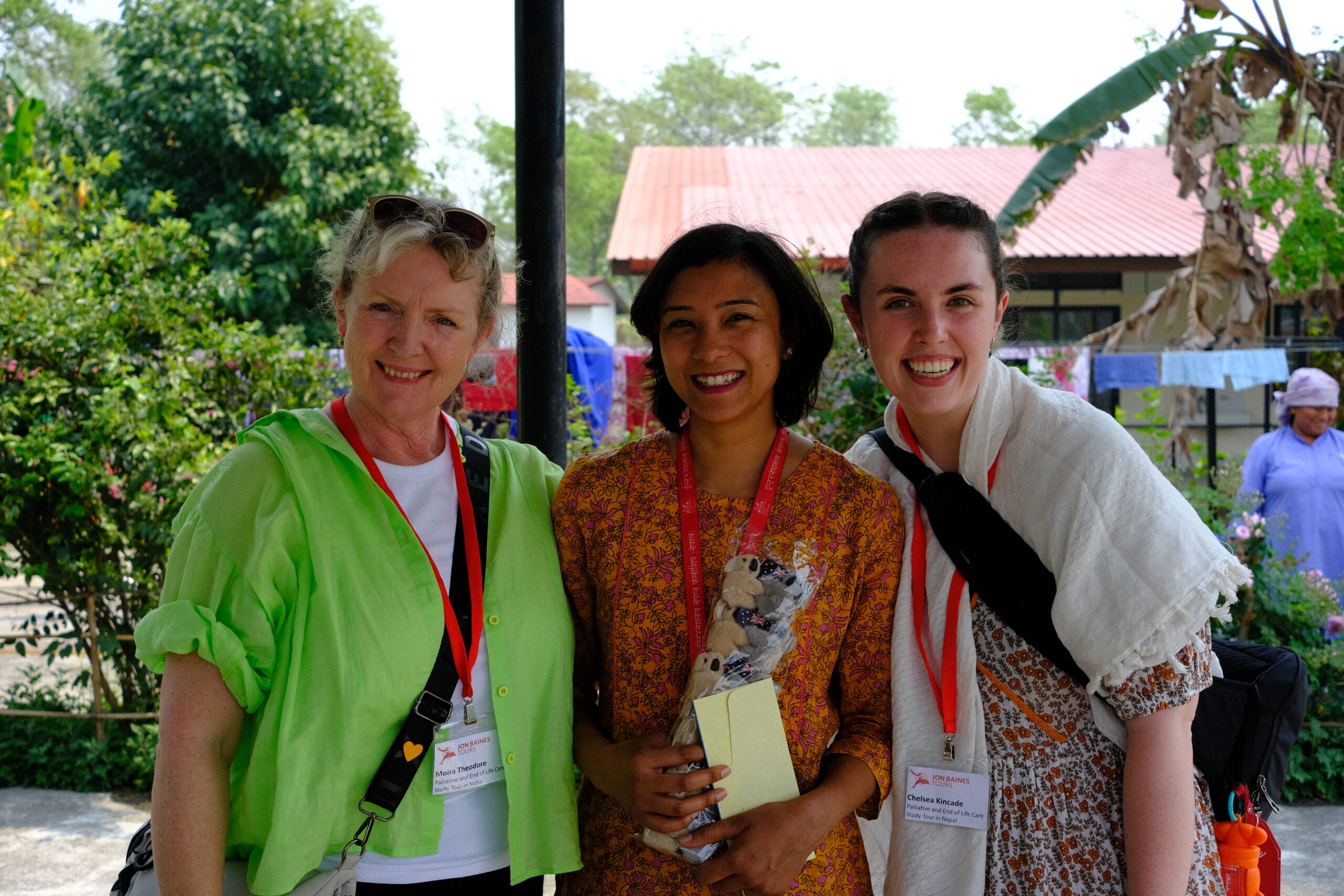
While palliative care is still in its infancy in Nepal, our staff witnessed impressive, “out-of-the-box” initiatives that rely on the strength of the community.
Across the 11-day trip, they observed how medical care in Nepal is closely integrated with traditional and spiritual support structures.
Hospice nurse Chelsea Kincade shares her reflections on the trip and how she hopes to apply these learnings at Very Special Kids:
I was inspired to travel to Nepal after seeing this sobering statistic:
“In Nepal, more than 70 per cent of adults and 80 per cent of children with cancer die from their disease…”
With the incidence of disease-related deaths being so high, I felt that there was so much to be learned and applied to how I as a palliative care nurse can care for children, young people and their communities at Very Special Kids.
Palliative care with limited resources
The most surprising aspect of palliative care in Nepal is that end-of-life care appeared to have been done exceptionally well with very limited resources.
I observed death existing much more openly within communities and everyday life. My impression was that families exhaust every option before considering relocating to a healthcare facility. Community care is massive and moving a loved one to a hospice is often seen as a last resort.
For health professionals alike, good end-of-life care is not defined by medication, equipment or medical intervention alone. The simple acts of noticing someone, responding to their needs and treating them with respect had an impact no resource could replace.
The experience reinforced a strong sense of privilege in the resources available at Very Special Kids House. It highlighted that compassion at Very Special Kids is not secondary to clinical care, but central to how a good quality of life is delivered.
Compassion is not just a fallback when we lack tools – it is an active, skilled and deliberate form of care that shapes the experience of life and death itself.
Death isn’t a feared topic of discussion
I think in Australia, we want everyone and everything to last forever. Here, death and dying can be an uncomfortable subject, whereas in Nepal, there is a widespread appreciation that nothing in life lasts forever, and the notion of impermanence is widespread.
Death literacy is high because death is visible; it isn’t “tip-toed” over. It is not feared in Hindu and Buddhist culture.
I witnessed human cremations along the banks of the Bagmati River; it was one of the most profound and confronting experiences of my life. In Nepalese culture, public cremations reflect deeply held Hindu beliefs that death is a sacred and natural transition, rather than something to be hidden.
Standing at the edge of the river and observing the rituals unfold with such openness and reverence, I was struck not only by the physical reality of death but by the deep spiritual meaning woven into each act.
Cremation rituals are performed openly to honour the deceased, fulfil important family and spiritual duties, and assist the soul’s journey toward enlightenment. Their visibility within everyday life reinforces communal acceptance of mortality and the continuity of life and death.
In contrast, the fear of death often observed within Australian society may be less about death itself and more a reflection of limited knowledge, exposure and literacy surrounding the realities of dying. This is something we can really learn from as a society.
Defining a ‘good death’
This trip made me think deeply about what a ‘good death’ means. While I may not have a single answer, I believe it encompasses both the experience of dying and the deep care and meaning surrounding it. I have returned with a stronger focus on the power of non-pharmacological support and a more holistic approach to the children and families I serve.
On this International Nurses Day (Tuesday 12 May) we are honouring the vital role our nurses and personal care workers play in providing world-class care to children and young people with life-limiting conditions. We wish all our hardworking nurses and personal care workers a happy International Nurses Day.
Very Special Kids supports our employees through meaningful professional development opportunities, enabling them to continuously build capability, broaden perspectives and deliver the highest quality care to children and families.
